
Low Altitude Is, in Essence, Order in a Layer of Airspace
An eVTOL is not one aircraft. It is a new layer of airspace economy, and the airworthiness certificate is that layer's order.
Founders in low altitude are chased around by one question: are we building an aircraft, or are we building something else?
The view up front. An electric vertical take-off and landing aircraft, the eVTOL, is not one aircraft being built. It is a new layer of airspace economy. Building an aircraft is an engineering problem. Building a layer of airspace is a systems problem. Why? In three parts.
1. Turning a Layer of Airspace into an Economy Does Not Lack Imagination
Airworthiness certification, vertiports, airspace management, an operating network — none can be missing. Put together, they are what is called Urban Air Mobility. Plainly said, it turns flying into a shuttle you can put on a timetable. Aircraft, vertiport, air traffic control, operations: four parties assembled before there is a single shuttle run. The use cases have been sitting there all along: sightseeing, flight training, short-haul transport, cargo, emergency rescue, urban travel — six of them, not one missing. What is missing is patience.
There is a harder constraint underneath, set by physics rather than by market preference. Low altitude has to start at a high level of autonomy. Why? Because there is nobody on board to take over. A car on the ground still has a driver who can hit the brake; in the air that brake does not exist. Perception and decision have to be autonomous. Yet off-the-shelf radar cannot see clearly in the cluttered low-altitude environment, and aircraft makers are pushed one layer down into building their own sensors. That road is slower and pays off later. But slow is not wrong: a technical path set by physics is also the hardest to copy.
2. The Airworthiness Certificate Is the Order of This Industry
It is not a piece of paper. Whoever gets the Type Certificate first gets the first ticket into this layer of the economy. So what makes the ticket expensive? Time. Certification runs in years, not months, and that time cannot be bought or seized. We are fairly sure of this one. Before commercialisation works, what gets priced again and again is not orders. It is eligibility. And eligibility cannot be rushed.
Now the landscape. China stands on both the demand side and the supply side; Europe has long exported norms, institutions and certification standards. The product is built here, the standard is set there. Shipping a product abroad is not hard. Shipping a standard abroad is.
An unsettled standard is a risk, and also a window. Once a standard hardens, latecomers can only be passive certificate-holders, with cost and voice both locked in someone else's hands. While a standard is still forming, a company's engineering choices have a chance to be written into the industry default. So when we look at a low-altitude company, besides its current orders we look at whether it has a chair at the standards table. The people with chairs are writing the rules.
3. With This Kind of Narrative, First Ask Who Actually Pays
Grand infrastructure stories share one weak spot: the payer is missing. The budget, the operator and the locality rarely all pay in at once — the story stands, but nobody owns the bill. So what brings this layer of the economy down to earth? The cost curve. Once cost falls, the payer appears on its own. If it does not fall, no thickness of planning documents will bring it down to earth. In other words, the anchor on this line is the slope of falling cost, not the thickness of the paperwork. The ruler is not new, but it is often forgotten.
That is why we do not list low altitude as a direction of its own. The five directions on our site are: AI foundation models and wholly new paradigms; physical AI, embodied intelligence and robotics; commercial space, quantum computing, controlled fusion and brain-computer interfaces; AI infrastructure (advanced compute, power and energy, optical interconnect, edge computing); and intelligent manufacturing and hard-tech products that can compete globally. Five directions, one chain. Low altitude lands on two of them at once: it is physical AI that flies, and it is a hard-tech product meant to be sold worldwide. That is what the line in the Institute means when it is applied to low altitude.
We have walked with an eVTOL company through several financing rounds, doing a great deal of research and interviews, and watched a niche concept earn a hearing, bit by bit, at the capital level. This layer of the economy will not spread out in a year. But it is taking shape. It is not loud, but it is living water.
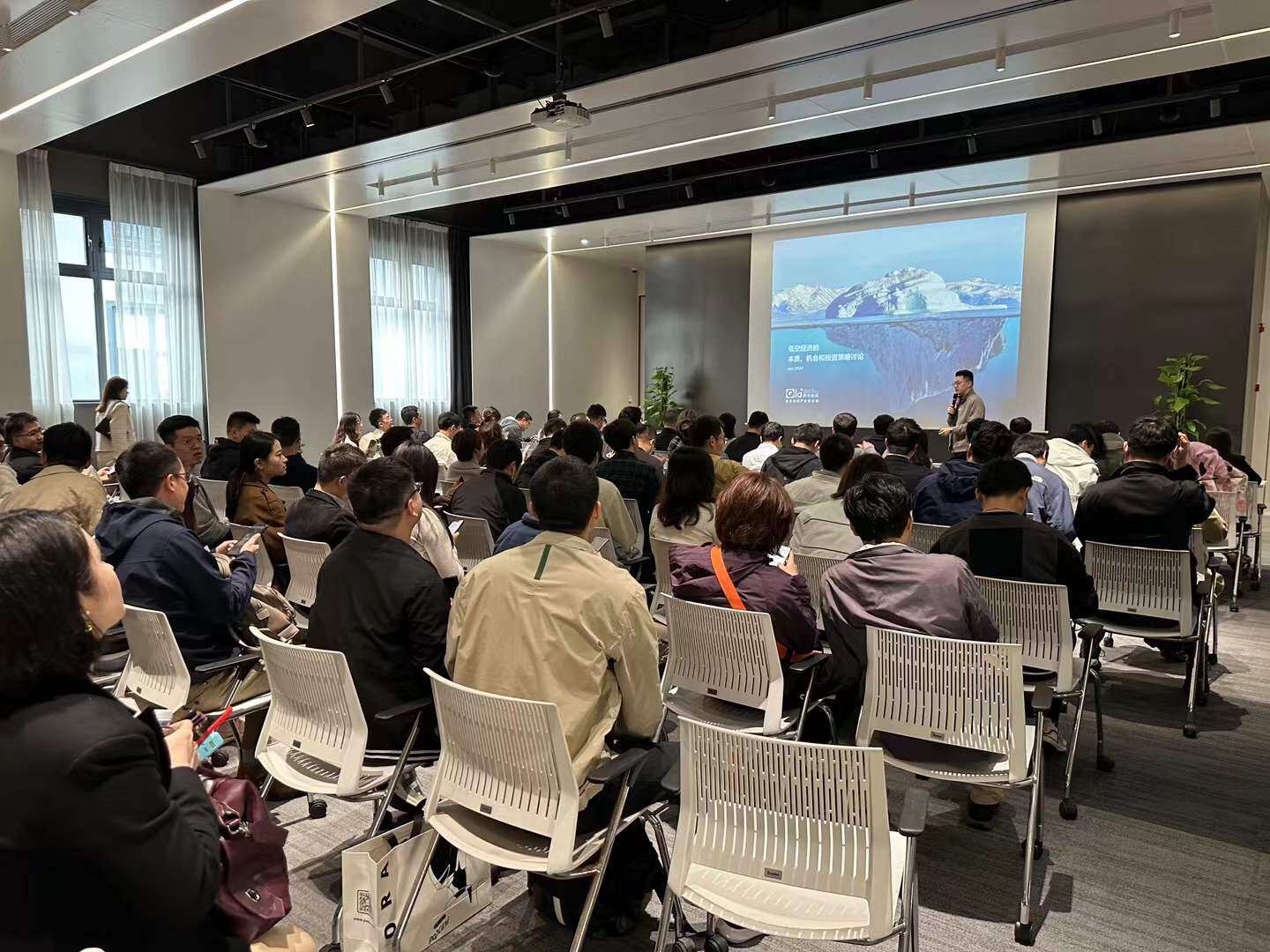
(For the full statement of our directions, see "Core Areas of Focus" in the Institute.)
- Where We Are Going
- Watch Fewer Launch Events, Go Look at the Line
- The Watershed in Embodied Intelligence Is Day One
- The Real Question in Driverless Logistics Is Operations, Not Demos
- Low Altitude Is, in Essence, Order in a Layer of Airspace
- The Complexity of a Rocket
- For Quantum, Change the Ruler
- The Longest Line
- Below Compute Is Electricity
- Hardware Starts Charging by the Month
- Before the Hong Kong Window, Ask Whether You Qualify